

Domperidone vs Itopride vs Levosulpiride-A prokinetic Guide
- A prokinetic agent is a drug that enhances gastrointestinal (GI) motility by increasing the frequency or strength of contractions in the stomach and intestines, without disrupting their natural rhythm.
Most commonly used prokinetic agent includes:
- Domperidone
- itopride
- Levosulpiride
A number of times the choice between these prokinetic agent becomes difficult, its because that we aren’t aware of their whole clinical insights which is essential to be known, by every physician and pharmacist, before initiating any of these reagent in any patient.
Here is the comprehensive yet Quick overview of clinical insights of prokinetic agents.
So, let’s began the battle!!!
Drug (domperidone) | Clinical Characteristics |
Nature | Antidopaminergic |
Therapeutic Class | Prokinetic/Antiemetic agents |
Mechanism of action | Block dopamine receptors (D2 and D3) in periphery to produce prokinetic effect and in chemoreceptor trigger zone (CTZ lie just outside the BBB, regulates vomiting) to produce anti-emetic effect. It’s also increase the level of prolactin in the body. |
Indication | Dyspepsia, indigestion, epigastric sense of fullness, epigastric pain, regurgitation, diabetic gastroparesis, nausea, and vomiting. |
Dosage forms availability | Oral, injection, and rectal |
Dosage and administration guidelines | Oral Adult Dose: for all indications 10-20mg orally 3-4 times a day 30 minutes before meal, maximum 80mg/day. Must reevaluate the need for continuation of treatment after every 4 weeks |
Precautions | Renal impairment, Electrolyte disturbance, Elderly (>60yrs) |
Contraindications | Prolactinoma, GI haemorrhage, perforation, obstruction, hepatic impairment or Cardiac Dysfunction |
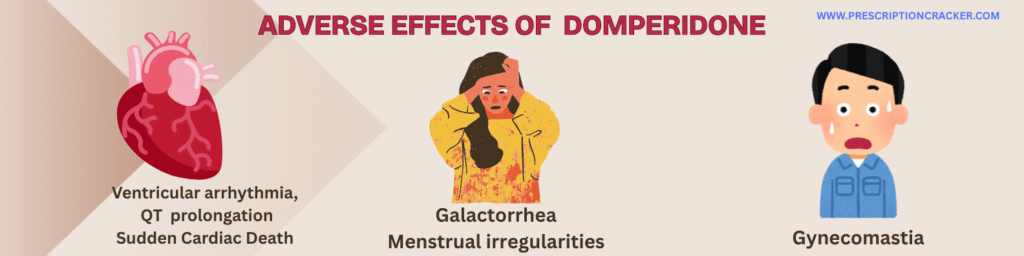
Adverse drug reactions | Ventricular arrhythmias, QT interval prolongation, Sudden cardiac death, Galactorrhoea, gynecomastia, or menstrual irregularities. |
Interactions | Ketoconazole, ritonavir, erythromycin |
Facts | ● Don’t Cross BBB so, less EPS. ● Not US FDA approved due to high cardiac toxicity. ● Approval in other countries is restricted to short durations and lowest effective doses, with warnings about ECG monitoring in high-risk patients. |
Common Brands | ● Motilium/Pelton (TABLET+SYRUP) ● Motilium V/Domel/Pelton V (Domperidone Maleate) ● Domflash ORO (Oro dispersible tablet) ● Pelton-C (Domperidone + Cinnarizine) |
|
|
Drug (ITOPRIDE) | Clinical Characteristics |
Nature | Antidopaminergic + Cholinergic agent (decreases AchE) |
Therapeutic Class | Prokinetic/Antiemetic agents |
Mechanism of action | Itopride is basically a dopamine D2 receptor antagonist which by antagonizing D2 receptors, also decreases the inhibitory effects of dopamine on acetylcholine (Ach) release. It also inhibits the enzyme AchE (that break down Ach) which increases the concentration of Ach. Thus, the overall result of the itopride administration is boost up in the level of acetylcholine (Ach) that leads toward the promotion of gastric motility, increases the lower oesophageal sphincter pressure, enhances gastric emptying and improves gastro-duodenal coordination. This dual mode of action of Itopride is exceptional, making it a unique choice among other prokinetic agents. |
Indication | Functional dyspepsia such as nausea and vomiting, non-ulcer dyspepsia (chronic gastritis), sensation of bloating, early satiety, upper abdominal pain, or discomfort, anorexia, and heart burn |
Dosage forms availability | Tablet (50mg or 150mg) and Capsules (150mg) |
Dosage and administration guidelines | Oral Adult Dose: 50mg orally 3 times a day 30 minutes before meal, or 150mg OD (once daily) 30 minutes before meal maximum 150mg/day. Not recommended in children. |
Precautions | As it increases Ach level thus can causes cholinergic effects |
Contraindications | GI haemorrhage, perforation, obstruction, or in cases where GI motility is harmful. |
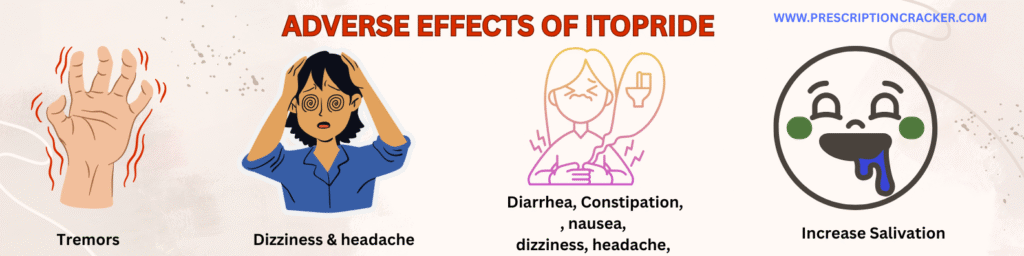
Adverse drug reactions | Diarrhea, Constipation, increase saliva, nausea, dizziness, headache, tremor, abdominal pain |
Interactions | Anticholinergic Drugs |
Facts | ● Don’t Cross BBB so, less EPS. Itopride is hydrophilic and is a substrate of P-glycoprotein (P-gp), which actively pumps it out of the CNS. ● Not US FDA approved due to lack of manufacturer’s interest ● Approved in other countries for the above-mentioned indication. ● No Cardiac Toxicity. |
Common Brands | ● ITP 50mg OR ITP OD (150mg) ● Emptin-OD 150mg and Emptin 50mg ● Ganaton 50mg and Ganaton OD 150mg ● Tespral 50mg |
|
|
|
Drug
(Levosulpiride ) |
Clinical
Characteristics |
|
Drug category |
Antidopaminergic
(Antipsychotic due to BBB penetration) |
|
Therapeutic Class |
Prokinetic/Antipsychotic |
|
Mechanism of action |
Levosulpiride acts as
a selective antagonist of dopamine D₂ receptors, both centrally (in the
brain) and peripherally (in the gastrointestinal tract) also act on CTZ, thus ●
Produces
antipsychotic effect, Increases prolactin levels, potential EPS ●
increases
the acetylcholine level and promote GI motility. ●
produces
anti-emetic effect |
|
Indication |
Dyspepsia,
Nausea, vomiting, vertigo, Inflammatory bowel syndrome (IBS), Schizophrenia,
Tourette’s Syndrome, depression with or without anxiety |
|
Dosage forms
availability |
Tablet (25mg and 50mg)
and Capsules (25,50 and 100mg) |
|
Dosage and administration guidelines |
Oral Adult Dose: 50mg -200mg daily
However the dose for CNS disorder may vary depending upon condition: Schizophrenia: 3-5mg/kg
daily to children over 14 yr of age. Adults:
Initially, 200-400mg twice daily, Maximum 1.2g BD if necessary, especially in
the case of patients with positive symptoms and Up to 800mg
daily in the case of patient with negative symptoms In case of
patient with neither predominating, are given usual dose of 400-600mg bd. Tourette’s Syndrome: Adolescents14-18
yr: 200-400mg bd. |
|
Precautions |
Should be careful
while giving it to manic or hypomanic patient, as it can exacerbate the
symptoms in such patients. |
|
Contraindications |
Comatose, CNS
depression, pheochromocytoma |
|
Adverse drug
reactions |
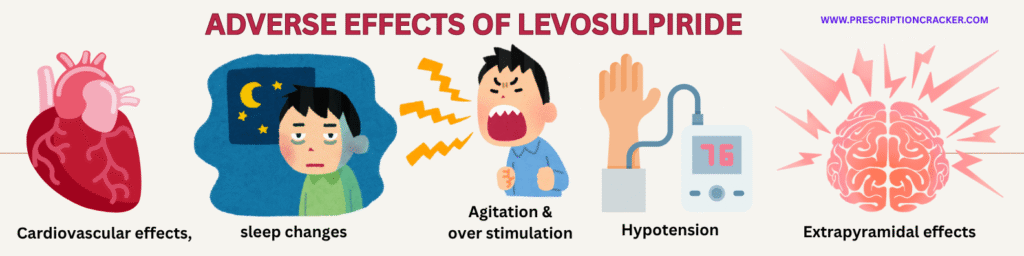
Extrapyramidal
effects, cardiovascular effects, hypotension, sleep changes, over stimulation
and agitation |
|
Interactions |
Anticholinergic
Drugs, Alcohol, CNS depressants, guanethidine, antacids, NSAIDs |
|
Facts |
●
Cross
BBB have EPS. ●
Not
US FDA approved due to lack of manufacturer’s interest ●
Approved in other countries for the
above-mentioned indication. |
|
Common Brands |
●
Sulvorid
25 and 50mg ●
Motivo
25 and 50mg ●
Lusell
25 and 100mg ●
Scipride
50mg ●
Sowel 25, 50 and 100mg |
|
|
|
So, what we get from the above clinical pearls is that one size doesn’t fits all.
Like if we see the safety profile of these prokinetic agents in patients suffering from cardiovascular disease we come to know that itopride has a good safety profile in cardiovascular patients. while domperidone can causes severe cardiac effect likewise levosulpiride also has negative effects on heart. which helps us choose the right medicine for the heart patients.
Similarly the decision to choose different prokinetic agents in different clinical scenario has been easy after having this comparison.
References:
DrugBank. (n.d.). Itopride. DrugBank Online. Retrieved June 22, 2025, from https://go.drugbank.com/drugs/DB09217
PharmaGuide Publications. (2019). PharmaGuide: Pakistan drug directory (26th ed.). PharmaGuide Publications.
DrugBank. (n.d.). Domperidone. DrugBank Online. Retrieved June 22, 2025, from https://go.drugbank.com/drugs/DB01184
DrugBank. (n.d.). Levosulpiride. DrugBank Online. Retrieved June 22, 2025, from https://go.drugbank.com/drugs/DB12855
Disclaimer:
This information is for educational purposes only and is not intended to replace professional medical advice. Always consult your doctor or pharmacist before starting or changing any medication.